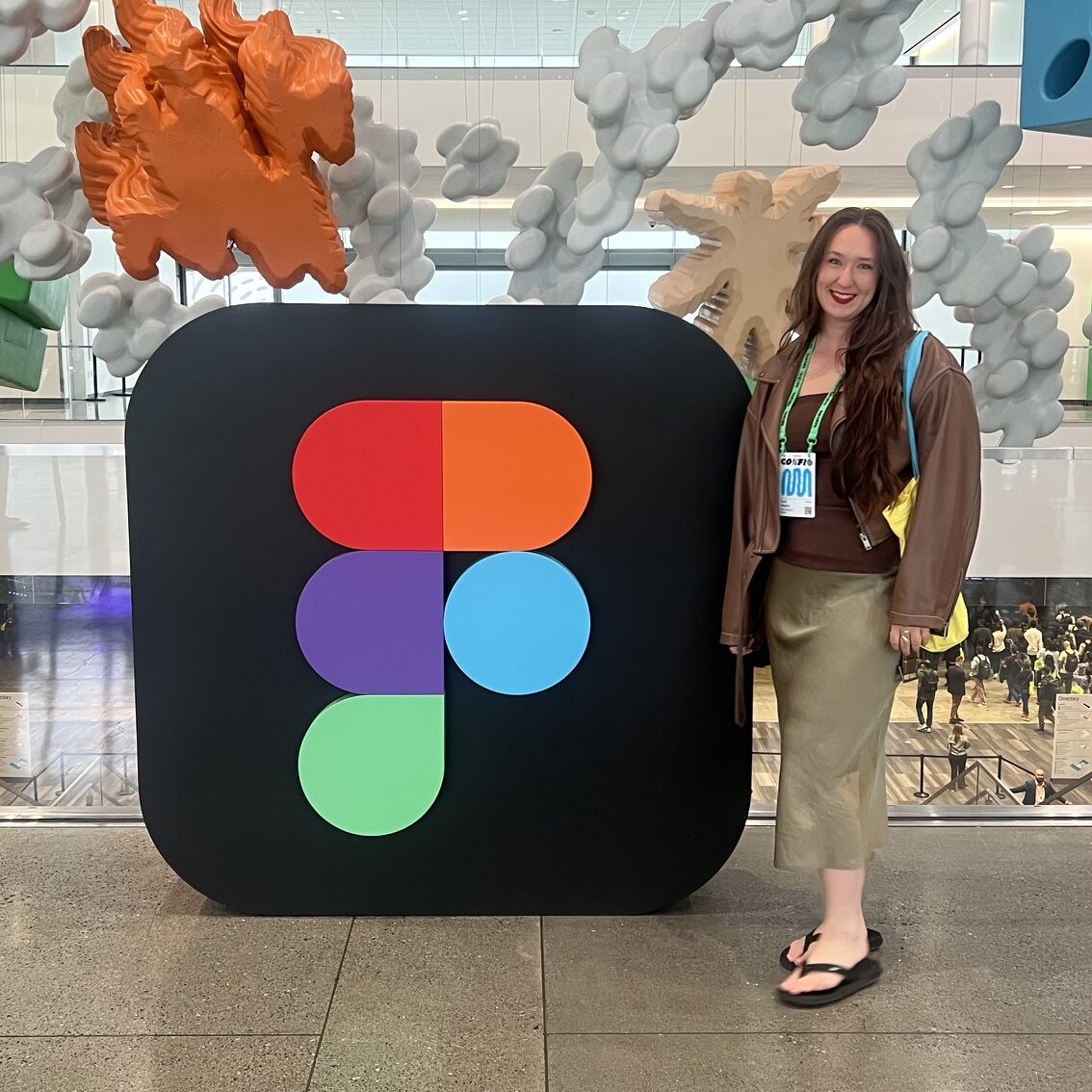
We talked with Tuuli Nele Valgma about the atmosphere at the Figma conference in San Francisco and the ideas she brought home with her. We also draw inspiration from Tuuli Nele’s career journey – how she got from working as a secretary to designing user interfaces, and what her day-to-day work as a UX/UI designer at Stebby looks like.
At the end of June you went to the Figma Config conference in San Francisco. For readers who may not be familiar with it, could you explain what kind of event it is?
Config is Figma’s annual conference, where designers, developers and product teams from around the world come together to share knowledge, get to know new tools and talk about where the design field is heading.
Although many people know Config primarily as the place where Figma announces its biggest updates, it is actually much more than that. It’s a place where people from very different backgrounds come together, all of them working towards creating better digital experiences.
There are all sorts of conferences out there – why did you choose Config?
Since this was the first conference of my life, I did quite a lot of research before going. I looked at other people’s experiences and read up on what Config is and what recommendations previous attendees had shared.
Our company sets aside a budget for development opportunities like this, and I felt that Config was the most fitting place for me to go.
It was also a particularly interesting experience for me because I’m currently the only designer at the company. Day to day, I have to make a lot of decisions on my own, and there’s no chance to simply bounce ideas off another designer sitting at the next desk.
Config gave me the chance to be surrounded, all at once, by thousands of people who are thinking about similar problems and challenges.
What was your first impression when you arrived at the venue? What was the atmosphere like?
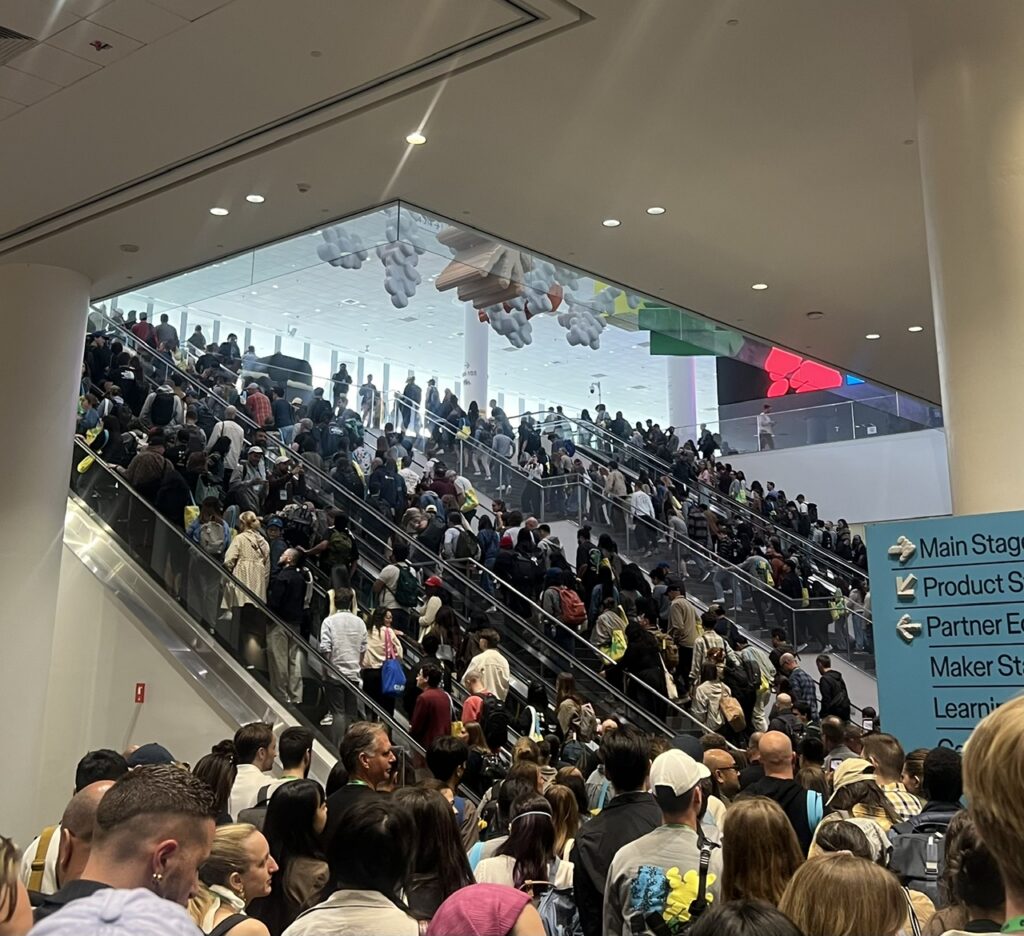
My first contact with the conference was actually already at the pre-event. Although Config officially runs for two days, you can go and pick up your tickets and merch beforehand and ease into the buzz of the conference at your own pace.
Many people recommended definitely attending the pre-event, because the queues the following day were supposed to be very long. And when we were told there were around ten thousand attendees, that wasn’t hard to believe – you could really feel the size of the crowd.
The moment I stepped in through security, the feeling was completely different. A DJ was playing music, people were greeting each other cheerfully, the security guards were dancing at the security gate and the whole atmosphere was full of excitement.
Honestly, I couldn’t wipe the smile off my face. It was a great feeling – like I’d ended up somewhere where everyone is genuinely interested in the same topics and wants to discover new things.
At the pre-event you could try out different workshops, talk to other attendees and quietly settle into the community.
Did you manage to meet any other Estonians there?
I didn’t find a single Estonian, but I did make some great new contacts and had conversations with people from different countries.
One thing the speakers also strongly emphasised was to keep communication open with everyone. A conference isn’t just a place to go and listen to talks – it’s an opportunity to broaden your worldview and build new connections outside your everyday work environment.
On both days I tried to find a good balance: to attend as many talks as possible, while still leaving time for conversations and simply enjoying the atmosphere.
What impression did the ideas and talks at the conference leave on you, and what resonated the most?
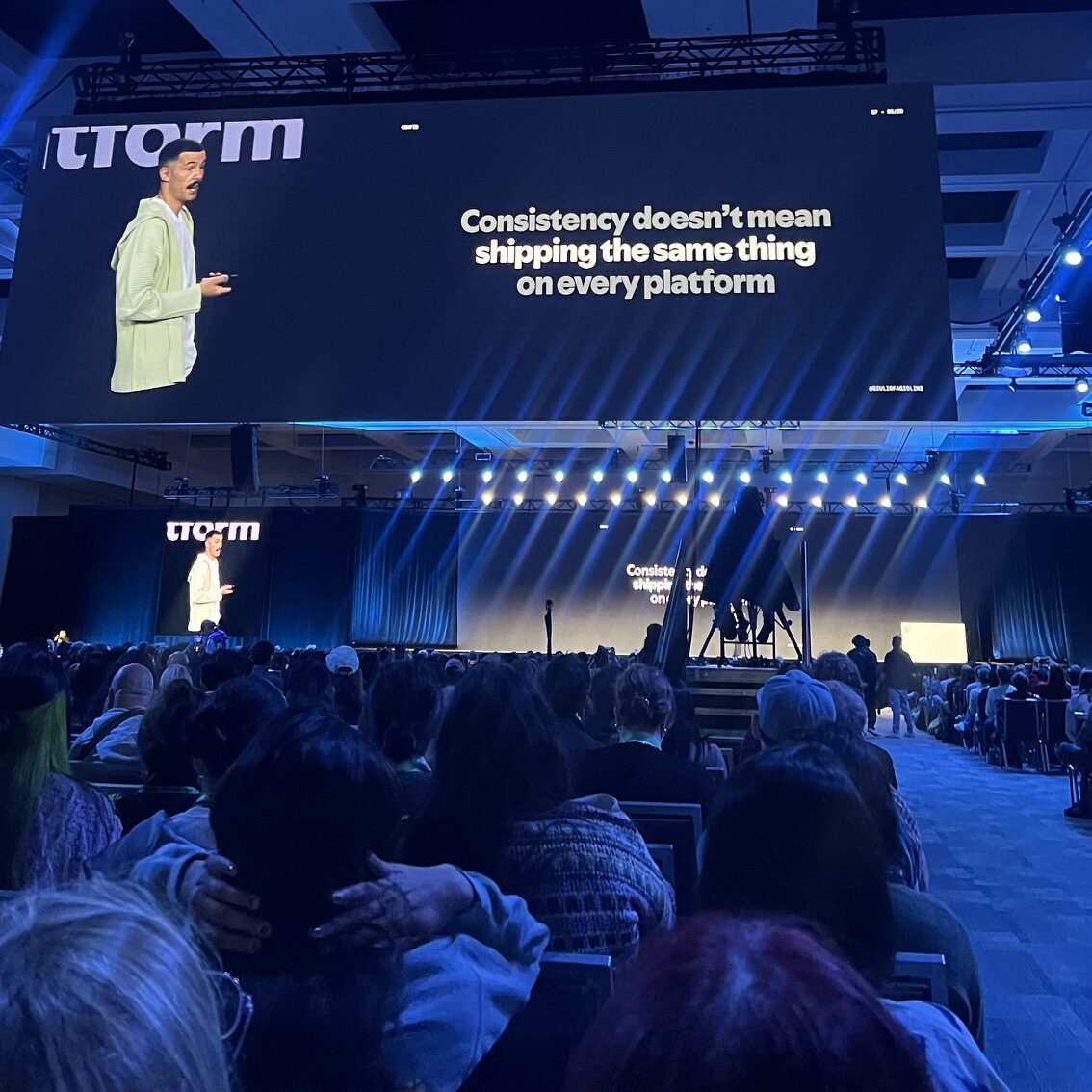
What I liked most was that people had come from all sorts of design fields. It wasn’t only UX/UI designers on stage, but also people from very different creative disciplines.
For example, there was a designer who talked about creating the visual identity of Charli XCX’s “BRAT” album and the whole process behind it. There was also a designer whose job is to create holograms and futuristic user interface visuals for films – the kind we’ve seen in movies like “Top Gun” and “Iron Man”. It was really inspiring to see just how broad the world of design can be.
For me, the valuable part was experiencing how the world’s top teams think about design. You can watch the talks online afterwards, of course, but being there in person created a completely different experience. You can immediately discuss with other designers what they think of some new feature, or how to apply it in your own work.
Figma’s announcement of its new solutions stuck with me especially strongly. This time they came out with very major updates, and you could feel that excitement across the whole hall. After every big announcement, people immediately started discussing how they’d start using those possibilities in their day-to-day work – especially when it came to AI and new workflows.
The thing that excited me most was Figma Motion. Motion design and animation have interested me for a long time, and I’ve created them in After Effects as well.
Until now, though, one of the trickiest parts has been how to hand animations over to a developer so that the end result survives intact and the collaboration is as smooth as possible. Figma Motion seemed to me like a very exciting step in the direction of letting designers create animations directly in their design tool and pass them on to developers in a far more understandable form.
The funniest part was that just a couple of days before the conference, my manager wrote to me suggesting I make a loading state animation for our product based on the logo. So when Figma Motion was announced at Config a few days later, my jaw honestly dropped. It felt like perfect timing – I had just been thinking about how complicated that process is right now, and then a tool came out that could make it much easier in the future.
It’s exactly these moments that show how fast our field is developing, and how important it is as a designer to keep learning and stay open to new possibilities.
Another idea that stayed with me strongly had to do with design systems. They don’t have to be rigid, or thought of as a final set of rules you must never deviate from. Consistency matters, of course, but you always have to leave room for creativity and growth.
And perhaps my favourite lesson had nothing to do with Figma at all.
Many of the speakers talked about where they find inspiration, and surprisingly few of them mentioned Dribbble or Pinterest. Instead they pointed to paintings, photography, architecture, nature, random textures, street signs and everyday objects. One designer even said he keeps a large photo album where he collects pictures from different places and organises them by colour, so he can find new ideas and inspiration later.
It reminded me that good design doesn’t come only from looking at other design work, but from observing the world itself and being curious about everything around you.
Thinking back to the beginning of your career – what brought you to UX/UI design?
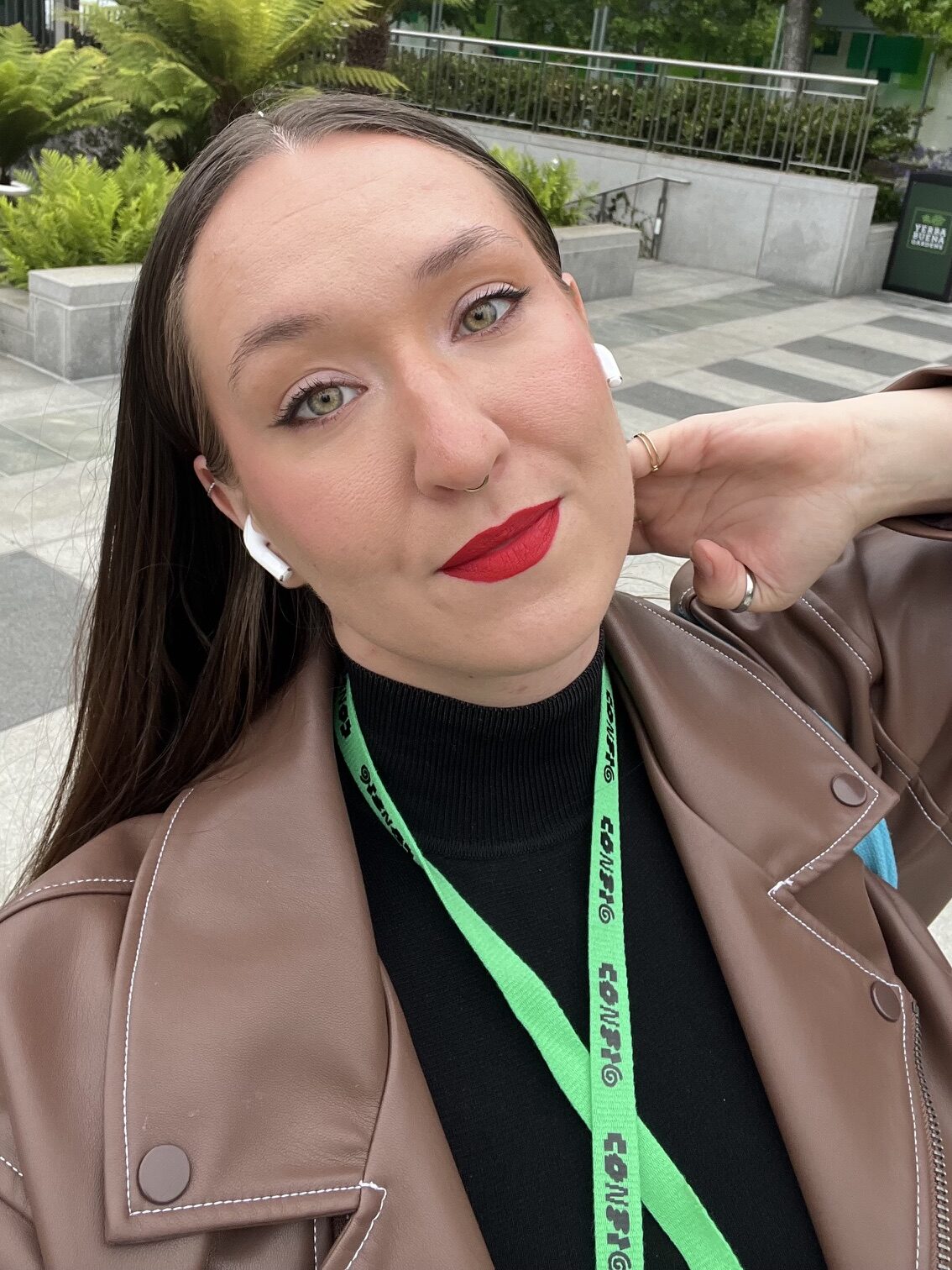
In my early twenties I was a fairly typical young person still looking for my place.
I had a creative background, I was doing photography, I worked as a secretary, and I knew that neither of those was quite the thing I wanted to tie the rest of my career to. I saw photography more as a hobby or a side activity than as a main source of income.
At some point a friend introduced me to UX/UI design as a possible career direction. Honestly, my first thought was exactly what most people probably think – “that’s some IT thing.” But the more I looked into the field, the more I realised that it actually combines two things that matter a lot to me.
First, I get to be creative in my work. And second – perhaps even more importantly – through my work I get to genuinely help both users and the company. Good design doesn’t just mean beautiful screens; it means a person gets their goal done more easily and the product works better. That mindset was the decisive moment for me, when I understood that I wanted to learn this profession.
I set myself a fairly ambitious goal: a complete career change in six months. The plan was to leave my job as a secretary, take time to study, do as many courses as possible, build a portfolio, find an internship and finally get a job as a UX/UI designer. In hindsight it sounds like an almost too simple plan, but in reality it took a great deal of work and persistence.
Since I was a complete beginner in UX/UI, I turned to you (Artur Puiste) for help in planning my learning journey, and together we mapped out a plan for reaching the goal step by step.
I took the UX Estonia courses, and they gave me a strong foundation. Just as important as the knowledge was the confidence I gained – the feeling that this goal was genuinely achievable. Looking back, it was a very important launchpad for my career.
Where do you work today, and how would you describe your day-to-day work to someone who isn’t familiar with the UX/UI designer role?
Today I work as a UX/UI designer at Stebby.
Before that I spent nearly two years at a design agency, where the pace was very fast and the projects changed constantly. That taught me to adapt quickly, to understand the needs of different clients and to solve very different kinds of problems. At the same time, I already knew back then that at some point I wanted to try product design too.
I was drawn to the idea of focusing on one product over a longer period – getting to know it inside out, understanding users needs and consistently making small changes that over time create a much better experience.
Today I get to do exactly that every day. I like being able to go deep with one product, follow its development and constantly look for ways to make it even better. What makes it especially meaningful for me is that Stebby operates in the health and wellbeing space – something I believe in myself and whose impact I see in real life.
Naturally, stepping into a new role came with a fair amount of anxiety too. Being the only designer at the company means a lot of responsibility, and many decisions have to be thought through and justified on your own.
At the same time it’s been an enormously developmental experience. In addition to designing new features, I’ve been able to work a lot on building and documenting our design system. A well-thought-out design system isn’t just a collection of components – it helps ensure a consistent user experience, speeds up development and makes collaboration significantly smoother for the whole team.
If someone asks what a UX/UI designer does day to day, for me the answer is simple: we solve problems. Sometimes that means listening to users and understanding their needs, sometimes prototyping new solutions in Figma, and sometimes long discussions with developers or product owners. Drawing screens is actually only a small part of the job. Most of the time goes into understanding what problem we’re even solving, and how to do it as well as possible.
Which skills do you think matter most for someone interested in becoming a UX/UI designer to develop into a good one?
I think the most important quality in a good UX/UI designer is curiosity. The ability to constantly ask “why?” – why does the user do something, why does one solution work better than another, or could this problem be solved in an entirely different way?
Empathy is also very important. We don’t design for ourselves, but for real people, which means you have to be able to look at the product from the user’s perspective.
A good designer also never works alone. The ability to communicate, collaborate and take feedback is just as important as a good visual eye.
And the more you also understand the development side, the easier it is to create solutions that are genuinely valuable both to the user and to the team.
Above all of that, though, I believe the most important thing is the desire to keep learning. Design evolves very quickly, and in my opinion the best designers are the ones who stay curious even after they already have years of experience.